You’ve seen printed parts and wondered: how does 3D printing work? A printer slices a digital model into thin layers, then builds the object by adding material one layer at a time.
For the bigger picture of how new technologies like this take hold, read about what is innovation.
| Item | Value |
|---|---|
| Core idea | Joining material from 3D model data, usually layer upon layer |
| ISO/ASTM 52900 process categories | Seven categories |
| Charles Hull’s stereolithography patent | 1986 |
| Typical material waste, additive manufacturing | 5-10% |
| Typical material waste, CNC machining | 70-90% |
| Standard additive workflow | Five steps |
These figures come from the IEEE Technology Navigator and MX3D’s guide to additive manufacturing. Figures can change, so check the source before you rely on them.
What 3D printing actually does
The international vocabulary standard describes additive manufacturing as the joining of materials to make parts from 3D model data, usually layer upon layer, as the OPC Foundation specification quotes it. In plain terms, the machine puts material only where the finished object needs it.
That is the opposite of subtractive manufacturing, such as machining, which removes material from a solid block. It also differs from formative methods such as injection molding, which shape material using dies and pressure, according to the IEEE Technology Navigator.
You will hear “3D printing” and “additive manufacturing” used for the same thing. MX3D notes that ISO/ASTM uses the terms synonymously, though engineers often prefer “additive manufacturing” when talking about structural or production parts.
From digital file to finished part
Whatever the machine, the process usually follows a five-step workflow, as laid out by MX3D:
- Design: create a CAD model or a scan of an existing object.
- Slicing and path planning: software converts the geometry into machine instructions.
- Build: the machine deposits, sinters or cures material layer by layer.
- Post-processing: support removal, heat treatment, finishing or inspection.
- Qualification: the part is tested against its specification.
The step that surprises most newcomers is slicing. Slicer software intersects the model with a series of horizontal planes to produce the two-dimensional outline of each layer. It also handles mesh repair, wall thickness, support structures for overhangs and infill patterns.
The model itself is saved in a file format that describes its shape. Common formats include STL, which represents surfaces as a mesh of triangles, and newer formats like 3MF or OBJ that can store extra information such as color or materials, according to Wevolver.
Once a layer is finished, the printer moves a small distance and starts the next layer on top of the previous one. Settings chosen during slicing, such as layer thickness and build orientation, affect print quality, strength and build time.
What are the main types of 3D printing?
ISO/ASTM 52900 sorts the technology into seven process categories: vat photopolymerization, powder bed fusion, binder jetting, material jetting, material extrusion, directed energy deposition and sheet lamination, as listed by the IEEE Technology Navigator. The most common ones work like this:
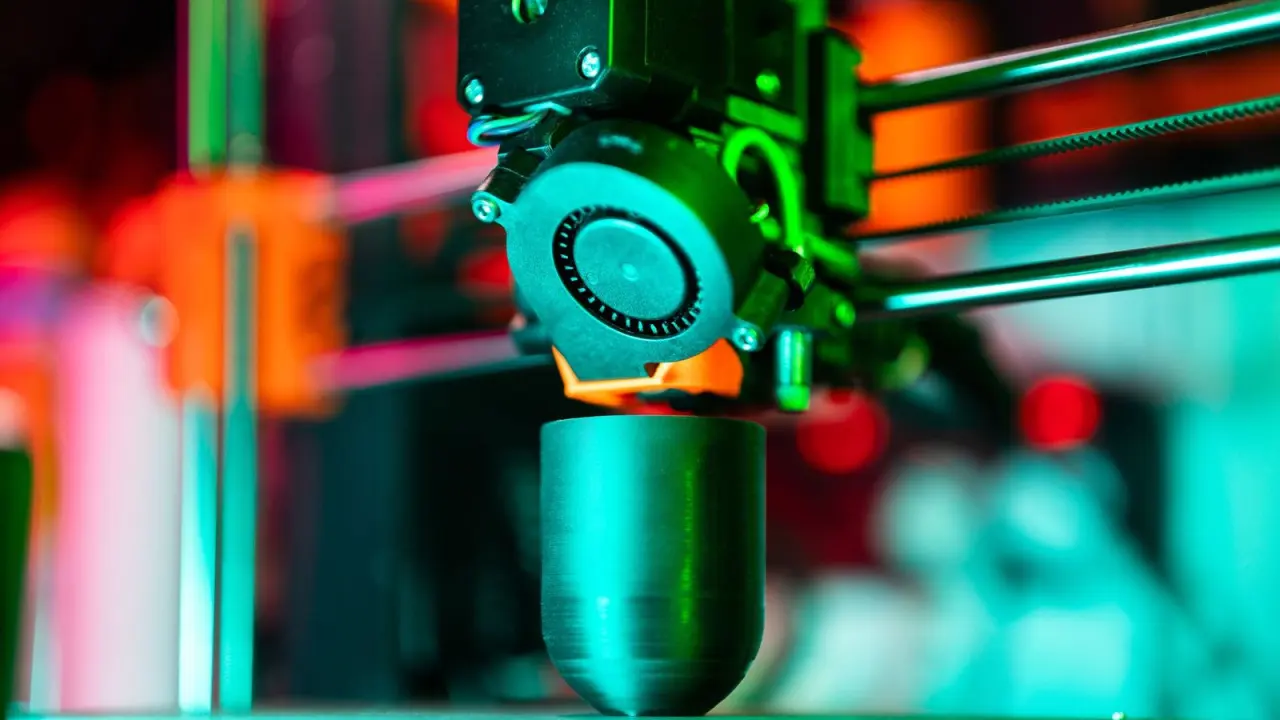
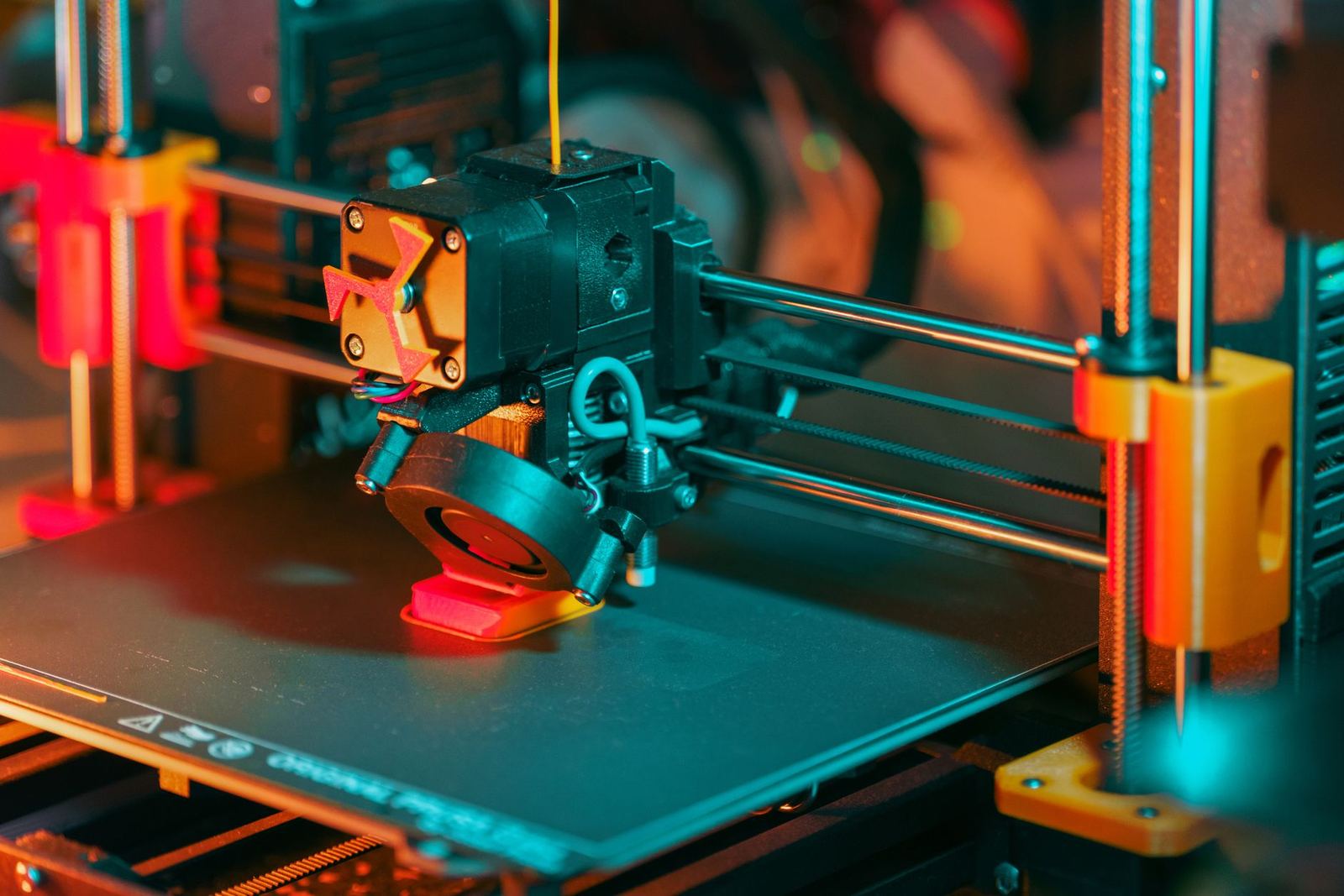
- Material extrusion: a thermoplastic filament is pushed through a heated nozzle and deposited along a computed path. This is the familiar desktop printer, often sold under the name fused deposition modeling.
- Vat photopolymerization: UV or visible light selectively cures liquid photopolymer resin. Stereolithography and digital light processing belong here.
- Powder bed fusion: a laser or electron beam fuses a bed of polymer or metal particles one layer at a time.
- Binder jetting: a liquid binder is deposited onto a powder bed to bond particles, and the parts are then sintered in a furnace.
- Directed energy deposition: metal powder or wire is fed into a focused energy beam and deposited onto a substrate, which also allows repair of existing components.
The first commercial roots go back to Charles Hull’s 1986 patent on stereolithography, which used an ultraviolet laser to cure thin layers of photopolymer resin, per the IEEE Technology Navigator. Later processes extended the idea to metals, ceramics and biological materials.
Each category trades off resolution, surface finish, material choice, build rate and post-processing. Vat photopolymerization is described by the IEEE layered manufacturing entry as achieving the highest dimensional resolution of any category.
Which materials can a 3D printer use?
Feedstock spans polymers, metals, ceramics, composites and biological substrates. Polymers such as PLA, ABS and nylon are the most widely used because they are inexpensive and suit material extrusion and powder bed fusion, according to the IEEE Technology Navigator.
Metal printing uses titanium alloys, stainless steel, aluminum and cobalt-chrome alloys. These serve aerospace, medical implant and tooling applications, typically through selective laser melting or directed energy deposition.
At the specialist end, hydrogel bioinks that encapsulate living cells are the basis for bioprinting of tissue constructs and organ models.
Strengths and trade-offs of building layer by layer
The headline advantage is less waste. MX3D reports that material waste is typically 5-10% with additive manufacturing, against 70-90% with CNC machining.
There is also no tooling to build. The IEEE layered manufacturing entry says the same file can drive production of one part or a thousand without tooling or fixturing changes. That flexibility makes printing popular for early test versions, a practice that fits the ideas behind what is a minimum viable product.
The trade-offs are real, though:
- Supports: structures that hold up overhanging features add material and post-processing time.
- Anisotropy: mechanical properties can differ between the build direction and the in-plane directions, so designers must account for it.
- Surface finish: surfaces are stepped at the layer scale, so sanding, polishing or chemical smoothing is typically needed for functional surfaces.
- Speed at volume: injection molding and similar methods are much faster for large production runs, according to Wevolver.
Where is 3D printing used?
Printing pays off where complex shapes, customization or short runs justify it. The IEEE Technology Navigator lists several fields:
- Aerospace structural and engine components with complex internal geometries.
- Medical implants, surgical guides and patient-specific prostheses.
- Rapid prototyping and tooling for consumer products.
- Architectural models and experimental building components.
- Electronics, including conformal antennas and printed circuit substrates.
Printing depends on trusted digital files and well-managed data. If you want to explore another digital technology, read about what is blockchain technology.
Frequently asked questions
Is 3D printing the same as additive manufacturing?
Show answer
In everyday use, yes. MX3D says ISO/ASTM uses the terms synonymously, although the IEEE layered manufacturing entry notes that “3D printing” technically refers to a subset of processes involving an inkjet-style printhead.
What does a slicer do?
Show answer
A slicer divides the digital model into thin horizontal layers and generates the instructions the printer follows. It also decides how the part sits on the build platform and whether supports are needed for overhangs.
Does 3D printing really waste less material?
Show answer
Typically, yes. MX3D reports 5-10% material waste for additive manufacturing against 70-90% for CNC machining, though results vary by process and part.
Can a 3D printer make metal parts?
Show answer
Yes. Metal printing with titanium alloys, stainless steel, aluminum and cobalt-chrome alloys is typically done through selective laser melting or directed energy deposition, according to the IEEE Technology Navigator.